Design System Governance Framework
Contribution model • Workflow alignment • Long-term sustainability

Contribution model • Workflow alignment • Long-term sustainability
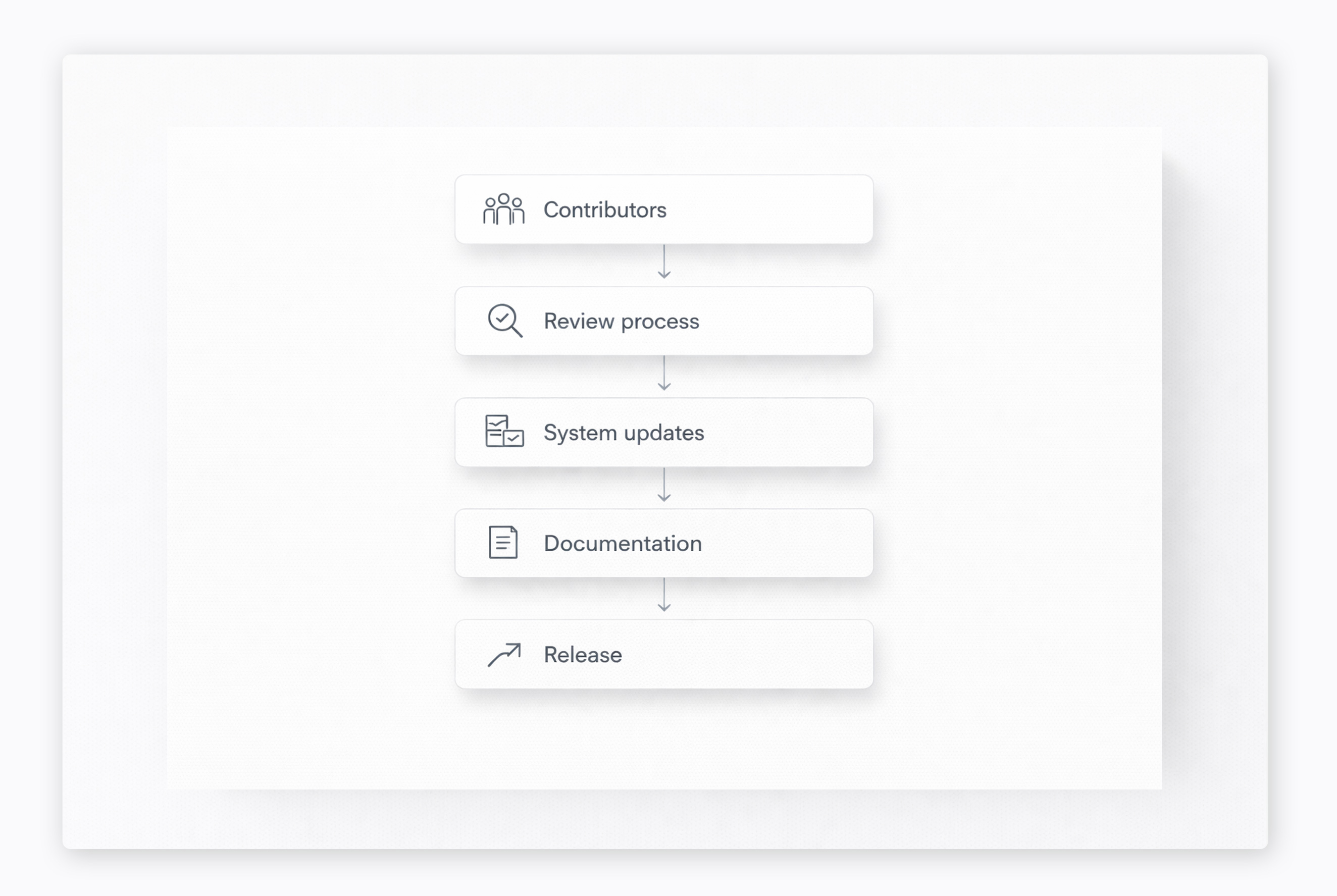
Established a formal contribution and governance framework to support long-term sustainability of a large-scale design system.
The work aligned ownership models, review workflows, documentation standards, and release processes to reduce friction across distributed teams.
This structure enabled controlled growth while maintaining system integrity.
As the design system expanded across schools and departments, contributions became decentralized.
Without defined governance pathways, inconsistencies emerged and system evolution slowed.
Sustainability required structure beyond components..
Design systems fail when ownership is unclear.
The challenge was to define: Contribution standards Review checkpoints Decision authority Documentation expectations Release process
Governance had to enable adoption without creating bureaucracy.
Reduced friction across design and engineering teams. Improved clarity around system ownership. Enabled controlled evolution without fragmentation. Strengthened long-term sustainability of the platform.
Macro-level system evolution across distributed academic teams.
Golden-ratio type scale and governed semantic token structure designed for consistency and accessibility.
Core tokens, semantic mapping, and controlled overrides to support multiple brands without fragmentation.
If your organization is scaling a design system and needs structure for long-term sustainability, I can help define contribution and review models that align teams and reduce risk.